Have you ever wanted to ask Dr. Cordain your questions...
I was recently interviewed by a reporter representing “The Academy...
You’ve heard of the benefits of the Paleo Diet but...
Over the past 5-7 years, more and more people worldwide...
It’s the time of year when the highly contagious...
A few days ago I was delighted to learn that...
I have noticed in the last few years that many...
Many of those that have made the switch to The...
Pork is a food particularly rich in B-vitamins. While many...
August 3 - 9 marks the USDA’s 15th Annual National...
Have you ever wanted to ask Dr. Cordain your questions...
I was recently interviewed by a reporter representing “The Academy...
You’ve heard of the benefits of the Paleo Diet but...
A few days ago I was delighted to learn that...
Over the past 5-7 years, more and more people worldwide...
I have noticed in the last few years that many...
The Nutritional Supplement Mentality When you start eating Paleo, you...
Over the years since the publication of my first book,...
Many of those that have made the switch to The...
Below is a recent success story from a Paleo Diet...
Real Paleo Fast & Easy
It’s finally here, the perfect Paleo cookbook for lifestyles on the go! 170 delicious recipes […]
Order Now
The Real Paleo Diet Cookbook (2015)
250 all-new reciped from the Godfather of Paleo! The return of the true Paleo Diet with […]
Order Now
The Paleo Answer (2012)
Dr. Loren Cordain’s bestselling The Paleo Diet and The Paleo Diet Cookbook have […]
Order Now
The Paleo Diet for Athletes (2012)
It’s finally here, the perfect Paleo cookbook for lifestyles on the go! 170 delicious recipes […]
Order Now
The Paleo Diet (Revised) (2011)
Dr. Loren Cordain demonstrates how, by eating your fill of satisfying and delicious meats […]
Order Now
The Paleo Diet Cookbook (2011)
Learn how to eat for good health by following the diet of our Paleolithic ancestors and eating […]
Order NowGet instant access to Loren Cordain's
Insider Collection on the many benefits of Paleo
when you sign-up for our email list.
The Paleo diet is based upon everyday, modern foods that mimic the food groups of our pre-agricultural, hunter-gatherer ancestors. Though there are numerous benefits eating a hunter-gatherer diet, there are seven fundamental characteristics of hunter-gatherer diets that help to optimize your health, minimize your risk of chronic disease, and to lose weight and keep it off.
Our bodies need much more protein than the average person consumes. In fact, protein accounts for only 15 percent of the average person’s daily calories, while 19 to 35 percent of the average hunter-gatherer diet was comprised of protein. This was due to the high consumption of meat, seafood, and other animal products prevalent in contemporary approaches to Paleo eating.
Combining higher protein intake and fresh vegetables leads to another major benefit: blood sugar stabilization. Between 35 and 45 percent of the average Paleo diet is comprised of non-starchy fresh fruits and vegetables that won’t spike blood sugar levels, making it an optimal diet for diabetes prevention. This is because nearly all of these foods have low glycemic indices that are slowly digested and absorbed by the body.
As you might expect from the previous paragraph, eating plenty of fresh fruits and vegetables naturally leads to higher fiber intake. Dietary fiber is essential for good health, and despite what you’ve probably heard, whole grains aren’t the place to find it. Non-starchy vegetables contain eight times more fiber than whole grains and 31 times more fiber than refined grains. Even fruits contain twice as much fiber as whole grains and seven times more fiber than refined grains!
With carbohydrates and protein intake already accounted for, fat intake comprises the rest of the Paleo diet. We’ve been taught that fat is something to be avoided at all costs, but it’s actually not the total amount of fat in your diet that raises your blood cholesterol levels and increases your risk for heart disease, cancer, and Type 2 diabetes; rather, it’s the type of fat that should concern you. The Paleo diet calls for moderate to higher fat intake dominated by monounsaturated and polyunsaturated fats with a better balance of omega-3 and omega-6 fats.
When following the Paleo diet, you will cut the trans fats and the omega-6 polyunsaturated fats in your diet and increase the healthful monounsaturated and omega-3 fats that were the mainstays of our ancestors. Recent large population studies, known as meta analyses, show that saturated fats have little or no adverse effects upon cardiovascular disease risk.
We’re in a position to understand more of the benefits of the Paleo diet now that we have a basic understanding of which food sources are emphasized. One major benefit of the Paleo diet is an increased consumption of vitamins, minerals, antioxidants, and plant phytochemicals. Whole grains are not a good substitute for grass-produced or free-ranging meats, fruits, and veggies, as they contain no vitamin C, vitamin A, or vitamin B12. Many of the minerals and some of the B vitamins whole grains do contain are not absorbed efficiently by the body. The Paleo diet cuts out whole grains and replaces them with unprocessed, fresh foods.
Fresh fruits and vegetables naturally contain between five and 10 times more potassium than sodium, and Stone Age bodies were well-adapted to this ratio. Potassium is necessary for the heart, kidneys, and other organs to work properly. Low potassium is associated with high blood pressure, heart disease, and stroke — the same problems linked to excessive dietary sodium. Today, the average American consumes about twice as much sodium as potassium! Following a Paleolithic diet helps to remedy this imbalance.
The final benefit we’ll discuss is a balanced dietary alkaline load. While this concept sounds complex, it’s actually quite simple: after digestion, all foods present either a net acid or alkaline load to the kidneys. Meats, fish, grains, legumes, cheese, and salt all produce acids, while Paleo-approved fruits and vegetables yield alkalines. A lifetime of excessive dietary acid may promote bone and muscle loss, high blood pressure, an increased risk for kidney stones, and may aggravate asthma and exercise-induced asthma. The Paleo diet seeks to reduce the risk of chronic disease by emphasising a balanced alkaline load.
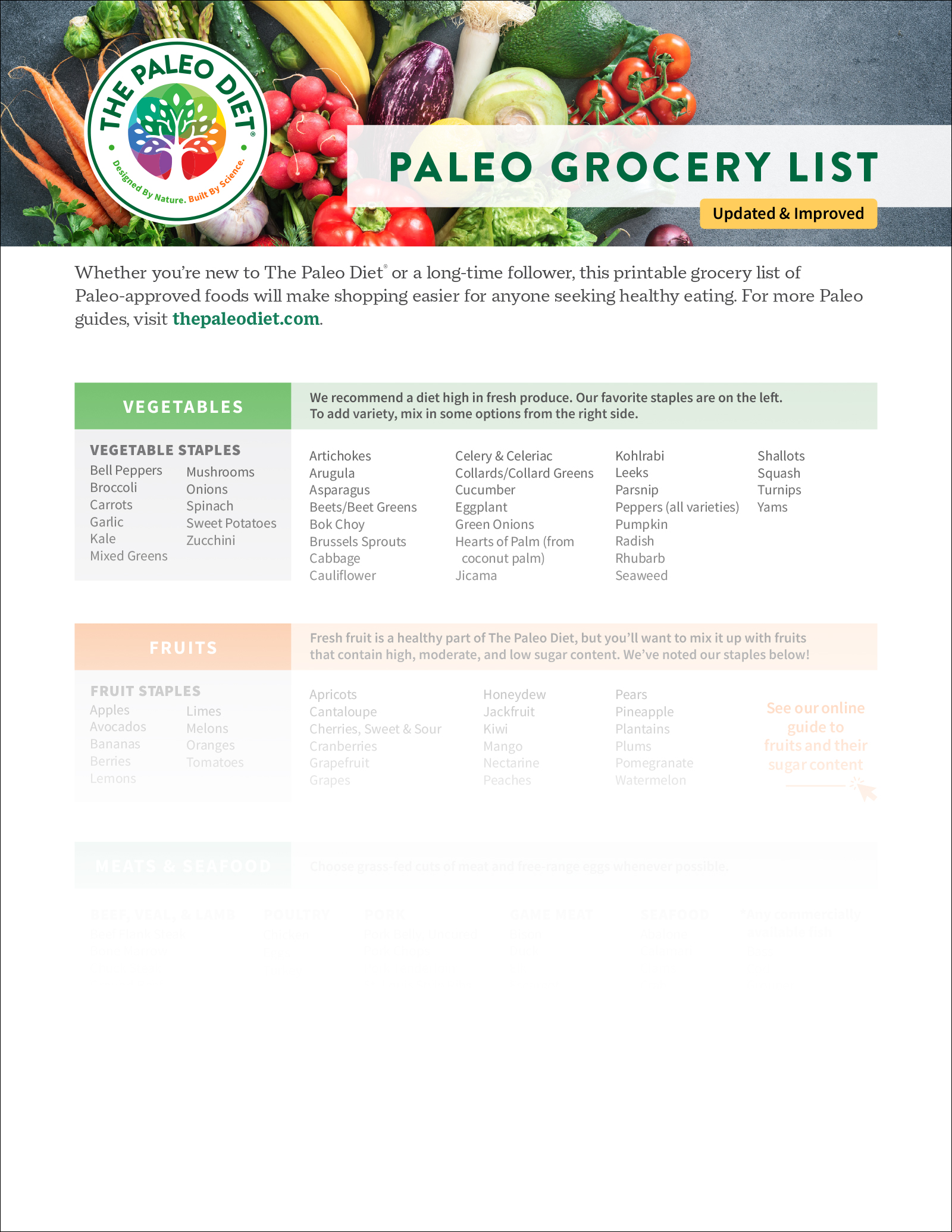
SO, WHAT SHOULD YOU EAT ON THE PALEO DIET?
Try these recipes!
Have you heard myths about the Paleo diet? Check here!
We’ve also answered some of our most frequently asked questions on this page.