Agrivoltaics: Combining Food Production with Solar Energy
For anyone who cares deeply about how food is grown, from the health of the soil to whether the land is being looked after or not, the question of energy production might seem like someone else’s problem. But land is everyone’s problem. And as demand for both food and clean energy continues to grow, the pressure on agriculture is becoming impossible to ignore.
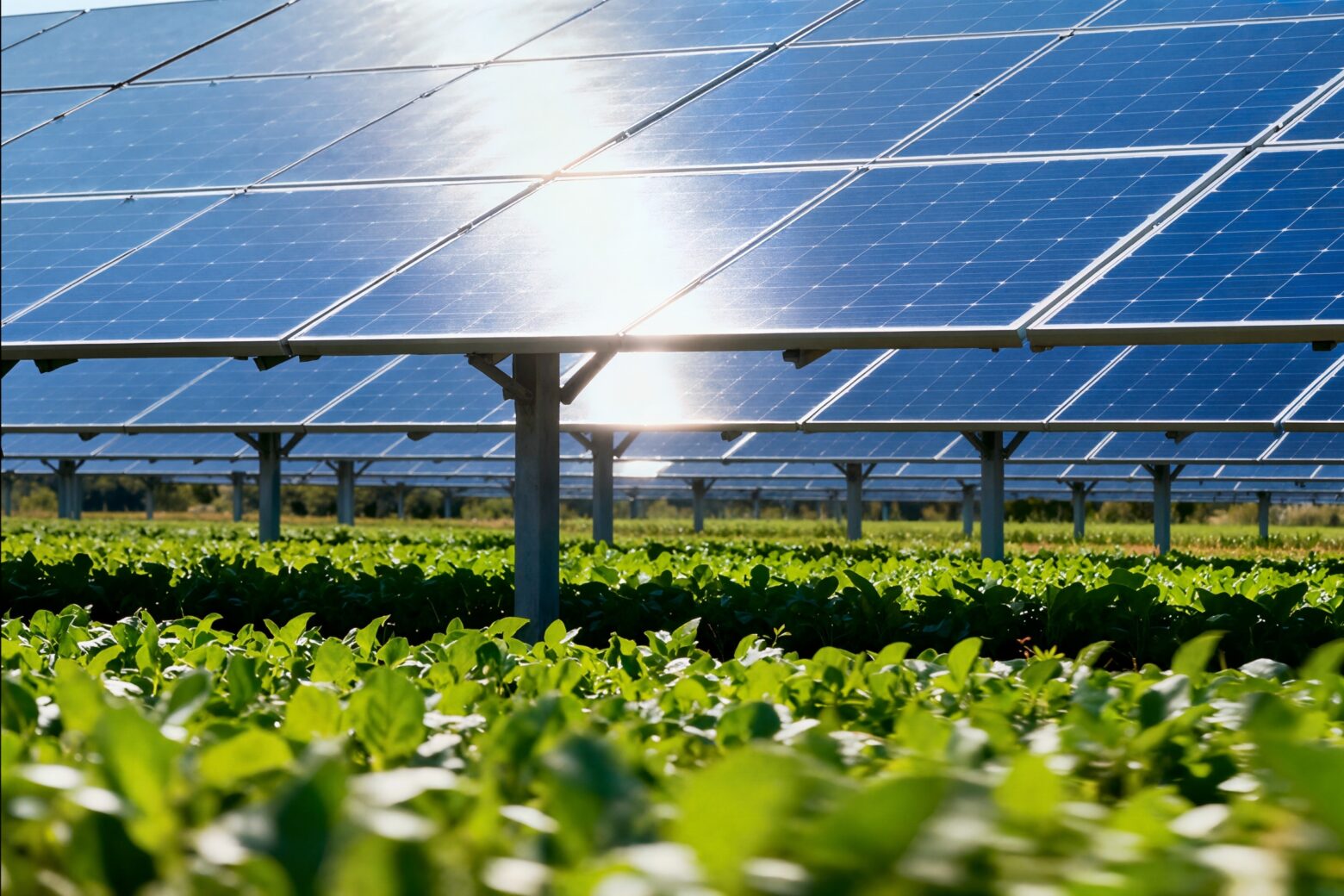
Agrivoltaics, a practice that integrates solar panels directly into working farmland, offers something rare in modern agriculture: a way to use the same land for both food production and energy generation. One piece of land doing two jobs.1,2,3
For those committed to eating in alignment with how humans have always interacted with the land, that idea is worth understanding.
Working with Natural Systems
At its core, agrivoltaics (also called agrisolar or dual-use solar) is simple: using the same land to produce both food and energy. Solar panels are installed above or alongside crops and grazing animals, but how this looks in practice can vary quite a bit depending on the farm, the crops, and the goals of the operation.
In some systems, panels are elevated high enough for tractors to pass underneath, keeping the land fully workable while generating electricity above. In others, panels are installed in rows with crops planted in the open spaces between them, creating a balance of sun and shade across the field.
Then there’s solar grazing, one of the most widely adopted approaches, where livestock (often sheep) graze beneath the panels. The animals help maintain the land and reduce the need for mechanical mowing, while benefiting from the shelter the panels provide. It’s a low-intervention approach that fits naturally within regenerative or low-impact farming models.
What makes these approaches genuinely interesting is the way they interact with the environment. The partial shade created by the panels lowers soil and air temperature, reduces water loss through evaporation, and protects plants from heat stress. Especially in hotter, drier climates, this can make a meaningful difference in how crops perform.4,5
Plants, in turn, give something back. Through transpiration (the process which plants release water vapor into the air), they contribute to a cooler microclimate beneath the panels, which can slightly improve solar efficiency.6 Each part of the system supports the other. It’s the same logic you see in any healthy ecosystem—nothing works alone, and the connections between things are often what matter most.
The details matter, too. The height of the panels, the spacing between the rows, and the degree of shading all need to be calibrated to the specific crops and climate involved.7 Done well, these systems support both food production and energy generation. Done poorly, it can compromise one or both.
What the Research Shows About Agrivoltaics
At the University of Arizona’s Biosphere 2 research center, Dr. Greg Barron-Gafford and his team put this theory to the test in a demanding growing environment: the Sonoran Desert. They grew chiltepin peppers, jalapeños, and cherry tomatoes beneath solar panels, and the results were hard to ignore.
The chiltepin peppers produced three times more fruit than those grown in open fields. The jalapeños required 65% less water. And the solar panels themselves ran more efficiently, cooled by the moisture the plants released into the dry desert air. This is a system that expanded production on both fronts: more food, more energy and less water.8
The University of Arizona findings are part of a growing body of evidence. In Germany, researchers from the Fraunhofer Institute for Solar Energy Systems documented a land use efficiency of 186% during a particularly hot, dry summer. Three of the four crops grown under the panels outperformed those in the open field, with celery yields up 12% and winter wheat up 3%—on the same land also generating solar electricity.9
Research at France’s Lavalette experimental site and Montpellier documented irrigation reductions of 14–29% under agrivoltaic systems compared with standard cultivation.10 These kind of improvements suggest that something genuinely different is happening.9,11
What Grows Well with Agrivoltaics (And Why It Matters)
Not every crop is a natural fit for life under solar panels, which makes crop selection one of the most important decisions in an agrivoltaic system. As a general principle, crops that tolerate or even prefer partial shade tend to perform best.
Leafy greens like lettuce, spinach, and arugula are the strongest performers. So are brassicas like kale, broccoli, and cabbage, as well as many herbs, berries, and certain root vegetables like carrots and radishes. For anyone eating a diet grounded in whole, nutrient-dense foods, that list will look familiar: these are some of the most health-supporting plants on the plate.
Crops that require full, direct sunlight (including widely cultivated, non-Paleo grains like corn and wheat) are less naturally suited to agrivoltaic systems, though ongoing research is exploring design configurations that may broaden what’s possible.
A Note on Soil
One dimension of agrivoltaics that deserves attention is what happens beneath the surface. Reduced soil temperatures, lower evaporation rates, and more consistent moisture levels create conditions that support microbial activity and soil health, the foundation of genuinely nutritious food.
This matters because soil health isn’t just a farming concern. It’s a food quality concern, too. The nutrient density of what we eat is directly tied to the vitality of the soil it came from. Any farming approach that protects and supports soil is protecting the integrity of the food.
RELATED: Why Soil Health Matters
Challenges and Considerations with Agrivoltaics
Agrivoltaics is promising, but it isn’t a simple solution. System design can be complex and upfront costs are typically higher than conventional solar installations. Factors like too much shade can reduce yields for the wrong crops, or poor airflow management can create humidity conditions that favor disease.
These aren’t reasons to dismiss the approach, however; they’re reasons to treat it as a system rather than a technology. Success depends on how well the system is designed and managed. The difference lies in design, intention, and ongoing attention—qualities that also define good farming.
A Different Way to Think About Land
There’s a deeper principle at work in agrivoltaics that goes beyond crop yields and kilowatt hours. It’s a challenge to the assumption that land can only serve one purpose at a time—that choosing food means giving up energy, or that building toward an energy future means sacrificing farmland.
That assumption has real consequences. Large solar installations have often raised legitimate concerns about removing productive agricultural land from food production. Agrivoltaics sidesteps that tension entirely.
For those who think carefully about how their food is produced, who understand that the health of what’s on the plate is inseparable from the health of the land it comes from, that shift in thinking is significant. It reflects an approach to land stewardship that is more integrated, more honest about interconnection, and more aligned with the way natural systems actually work.
As pressure on both food systems and energy systems continues to build, the solutions most worth paying attention to may be the ones that bring those systems together rather than pulling them further apart. Agrivoltaics, at its best, is one of them.
Resources
- Dupraz C, Marrou H, Talbot G, Dufour L, Nogier A, Ferard Y. Combining solar photovoltaic panels and food crops for optimising land use: Towards new agrivoltaic schemes. Renewable Energy. 2011 Oct 1;36(10):2725–32.
- USDA. (2018). USDA ERS – Home. Usda.gov. https://www.ers.usda.gov/
- Agrivoltaics. (n.d.). Regeneration.org. https://regeneration.org/nexus/agrivoltaics
- Marrou H, Guilioni L, Dufour L, Dupraz C, Wery J. Microclimate under agrivoltaic systems: Is crop growth rate affected in the partial shade of solar panels? Agricultural and Forest Meteorology. 2013 Aug;177:117–32.
- Elamri Y, Cheviron B, Lopez JM ., Dejean C, Belaud G. Water budget and crop modelling for agrivoltaic systems: Application to irrigated lettuces. Agricultural Water Management. 2018 Sep;208:440–53.
- Barron-Gafford GA, Pavao-Zuckerman MA, Minor RL, Sutter LF, Barnett-Moreno I, Blackett DT et al. Agrivoltaics provide mutual benefits across the food–energy–water nexus in drylands. Nature Sustainability. 2019 Sep 1;2(9):848-855. doi: 10.1038/s41893-019-0364-5
- Jeyasingh, Alex & Devakumari, M. & Manuel R, Isaac. (2025). Impact of Agrivoltaics irrigation and soil moisture dynamics A review. Journal of Emerging Technologies and Innovative Research. 12. 10.56975/jetir.v12i10.570091.
- Barron-Gafford, G. A., Pavao-Zuckerman, M. A., Minor, R. L., Sutter, L. F., Barnett-Moreno, I., Blackett, D. T., Thompson, M., Dimond, K., Gerlak, A. K., Nabhan, G. P., & Macknick, J. E. (2019). Agrivoltaics provide mutual benefits across the food–energy–water nexus in drylands. Nature Sustainability, 2(9), 848–855. https://www.nature.com/articles/s41893-019-0364-5
- Agrophotovoltaics: High Harvesting Yield in Hot Summer of 2018 – Fraunhofer ISE [Internet]. Fraunhofer Institute for Solar Energy Systems ISE. Available from: https://www.ise.fraunhofer.de/en/press-media/press-releases/2019/agrophotovoltaics-hight-harvesting-yield-in-hot-summer-of-2018.html
- Witwit IMT, Al-agele HA, Higgins CW. The effect of agrivoltaic system on nutrient content, yield, and water productivity of potatoes. Frontiers in Horticulture. 2025 Jul 7;4.
- Harvesting the sun for power and produce: Agrophotovoltaics increases the land use efficiency by over 60 percent [Internet]. ScienceDaily. 2017 [cited 2026 Mar 24]. Available from: https://www.sciencedaily.com/releases/2017/11/171127124817.htm
Maureen Farrar
Maureen Farrar has spent more than 20 years as a writer and editor for several print and digital outlets. She writes about health, fitness and nutrition.
More About The Author
Sustainability

The Paleo Diet® Newsletter
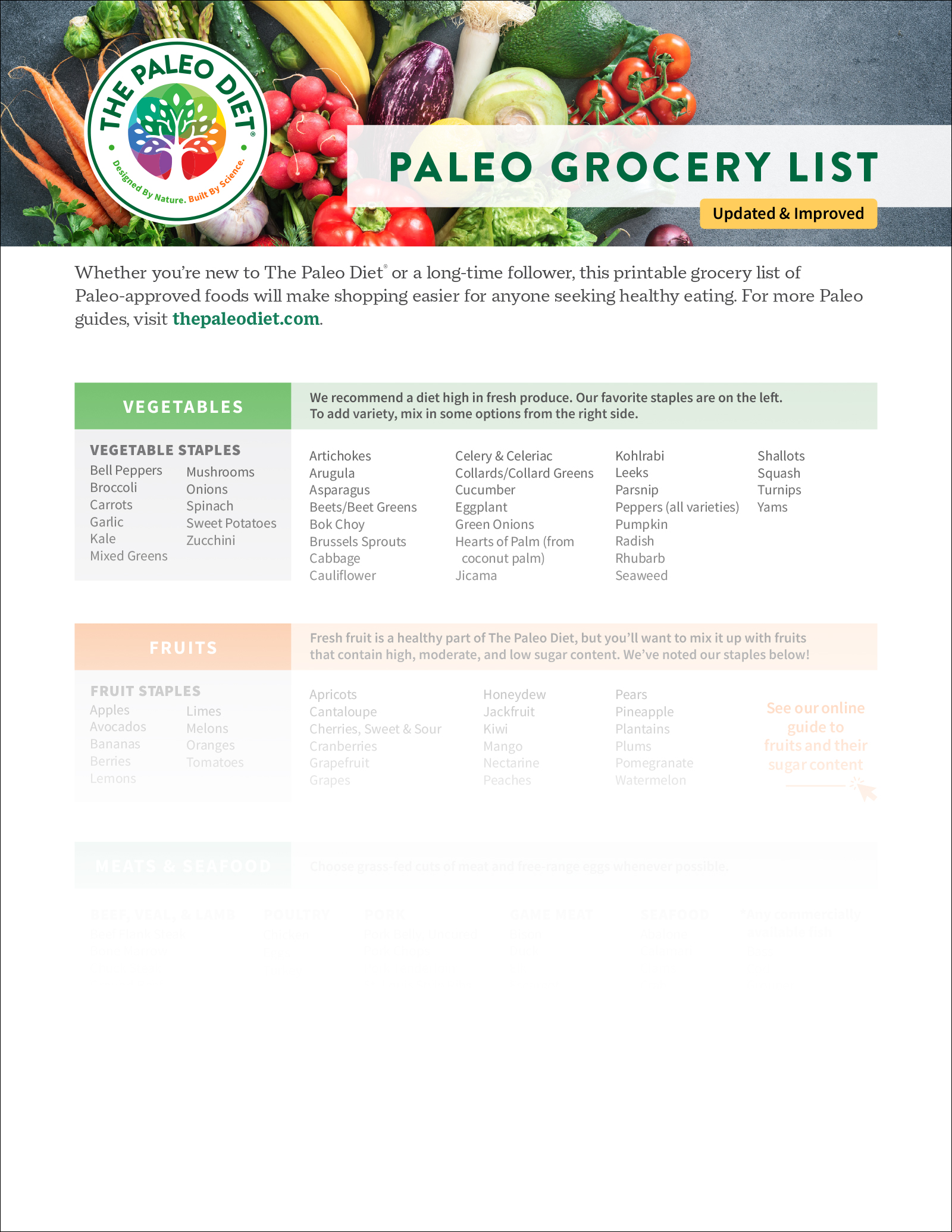
Sign up to get info on healthy nutrition, free recipes, meal prepping, and the latest health research. New subscribers will also receive our Official Paleo Grocery List!